When organisations plan a firewall refresh, the whiteboard is usually covered in diagrams of throughput, HA failover, and micro-segmentation. But there is a critical component arguably the most important physical one that is almost always treated as an afterthought.
The cable.
I’m not talking about Cat6 vs. Cat6A. I’m talking about what happens when that cable meets a spark. In a real-world incident, the wrong cable choice doesn’t just cause a network outage; it can accelerate fire spread and produce corrosive, toxic smoke that endangers lives and destroys the very hardware you just invested in.
Why "Jacket Material" is a Business Continuity Decision
In a modern comms room, you don't just have one cable; you have dense bundles. They sit in your racks, run through your ceiling voids, and travel up your risers.
That bundle is, effectively, fuel. If an electrical fault occurs, the material wrapping those copper wires dictates four things:
- Flame Propagation: How fast does the fire travel along the tray?
- Smoke Density: Can people see the exit signs to evacuate?
- Toxicity: Is the air breathable?
- Corrosivity: Will the smoke "eat" the circuit boards in the rest of your equipment?
PVC vs. LSZH: The Cost of "Cheap"
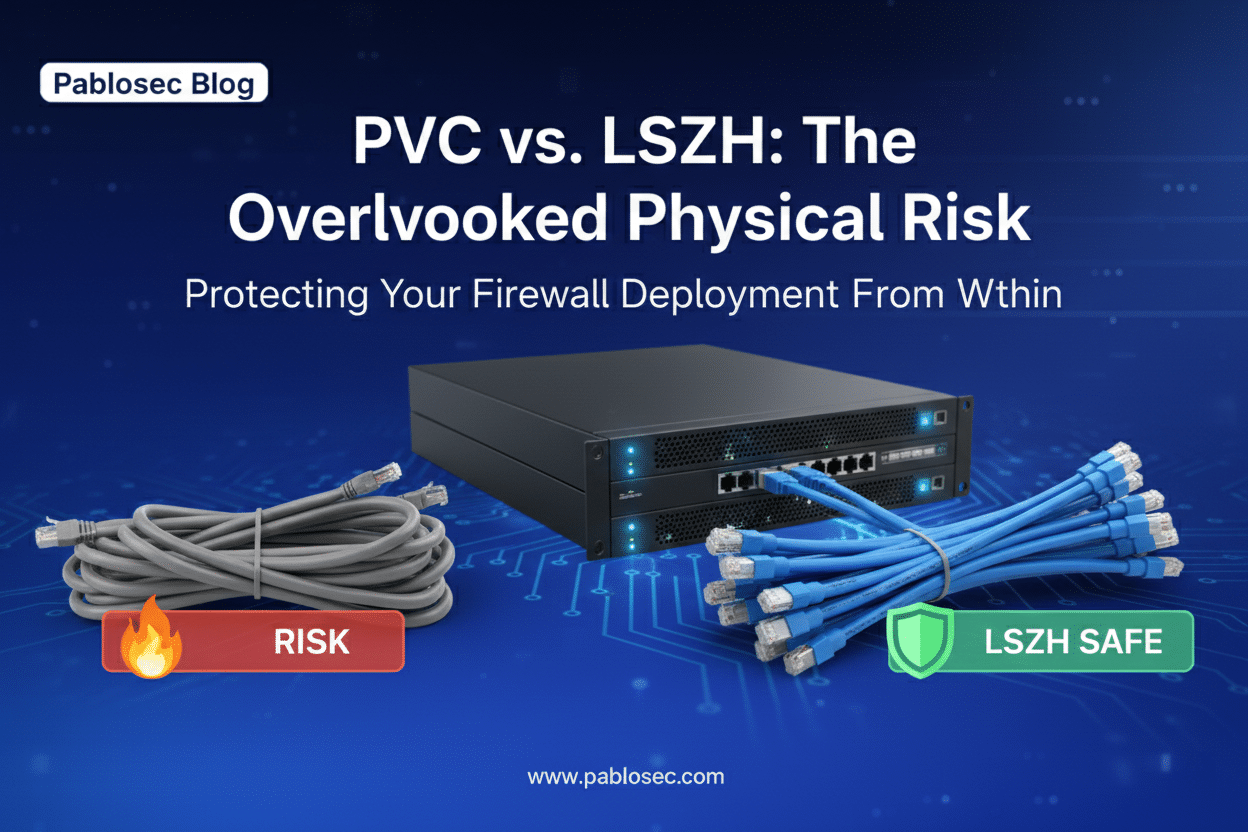
PVC (Polyvinyl Chloride) is the industry's old faithful because it’s flexible and inexpensive. However, PVC contains halogens (chlorine). When it burns, it releases hydrogen chloride gas. When that gas hits moisture like the humidity in the air or the lining of a person's lungs it turns into hydrochloric acid.
Even if the fire is small, that acidic smoke can drift into other racks, corroding the sensitive electronics of your switches and firewalls, leading to a total loss of equipment that wasn't even touched by flame.
LSZH (Low Smoke Zero Halogen) is engineered for the opposite. It is designed to produce thin, translucent smoke (keeping exits visible) and minimal acid gas. In short: PVC protects your budget; LSZH protects your people and your hardware.
Beware the "LSF" Trap
You will often see cables marketed as LSF (Low Smoke and Fume). On paper, it sounds safe. In reality, "LSF" is often just modified PVC. It might produce slightly less smoke, but it can still release significant amounts of toxic chemicals.
Pro Tip: If you care about toxicity and equipment protection, don't settle for "LSF." Insist on LSZH or LS0H with verified test references.
The Standards That Actually Matter
When a contractor tells you a cable is "safe," you need to ask: According to what standard? In Europe, we look for three key markers:
-
Flame Spread (IEC 60332): Does it stop burning when the flame is removed?
-
Smoke Density (IEC 61034): Does it pass the "3-metre cube" light transparency test?
-
Halogen Gas (IEC 60754): Does it emit less than 0.5% acid gas?
A Note on CPR (Construction Products Regulation)
For any cable being "permanently" installed in a building (horizontal runs, risers), it must have a Euroclass rating (B2ca, Cca, Dca, etc.) and a Declaration of Performance (DoP). While patch leads technically fall outside this regulation, using LSZH patch leads is still best practice to prevent your server rack from becoming a smoke bomb.
Why We Care About This During a Firewall Project
Firewall migrations almost always lead to increased cable density. You’re adding new segmentation, more PoE devices (APs, cameras), and secondary ISP lines.
If cable selection is treated as a commodity purchase, you’re potentially introducing an invisible fire risk into the heart of your infrastructure. At Pablosec, we believe security includes availability. You aren't "secure" if a small electrical fire in a ceiling void takes out your entire operation via corrosive smoke.
5 Questions for Your Next Refresh
Before you sign off on that cabling quote, ask your provider these five questions:
- Is the jacket PVC or LSZH?
- For building runs, what is the CPR Euroclass and can I see the DoP?
- Does the cable meet IEC 60754-1/2 for acid gas emissions?
- Is that "LSF" cable actually halogen-free, or just modified PVC?
- How will the increased cable density in our trays affect our fire load?
Final Thought
Cables are the cheapest part of a network upgrade, but they are the most expensive to replace if you get it wrong. Don't let a €5,000 cabling shortcut jeopardize a €50,000 hardware investment.
Building a new network or upgrading your perimeter? We don't just look at your policies; we look at your physical layer.