Most businesses invest in cybersecurity to stop hackers. But one of the biggest risks to your revenue isn't a data breach it's silence.
If your single firewall fails this afternoon, the outcome is brutal and immediate:
-
No internet.
-
No cloud apps (Microsoft 365, Salesforce, ERP).
-
No VoIP phones or Teams calls.
-
No payment processing.
-
No remote access for staff.
For many organizations, being offline for 24–48 hours while a replacement device is shipped isn't an "inconvenience." It is an operational crisis.
This is why we believe High Availability (HA) running two firewalls in tandem is no longer an "enterprise luxury." In 2026, it is a baseline requirement for business continuity.
The Firewall is Your Oxygen Supply
We often think of firewalls as "security guards," but in a modern network, they are the central nervous system. Your firewall handles:
-
SD-WAN routing for your cloud apps.
-
VPN tunnels connecting your branch offices.
-
SSL inspection for security compliance.
-
Network segmentation (Guest vs. Corporate vs. IoT).
If that single piece of hardware fails due to a power spike, a corrupted firmware update, or a simple fan failure, everything downstream stops.
The "Next Business Day" Myth
Even if you have a premium support contract with "Next Business Day" delivery, consider the timeline:
- Diagnosis: 2 hours with support to confirm the device is dead.
- Dispatch: The replacement ships (if the cutoff time wasn't missed).
- Delivery: The box arrives the next morning (best case).
- Configuration: An engineer must rack, patch, restore backups, and validate connectivity.
That is a minimum of 24 hours of dead air. Can your sales team afford to miss a day of calls? Can your warehouse afford to stop shipping?
What 48 Hours of Downtime Actually Costs
When the network goes dark, the damage isn't just technical; it ripples across the business.
1. Revenue Paralysis
If you are in retail or hospitality, card terminals stop working. If you are in B2B service, your team can't access the CRM to close deals or support clients.
2. The Productivity Vacuum
You are effectively paying your staff to wait. Without access to SharePoint, OneDrive, or the ERP, work grinds to a halt. We often see staff reverting to "Shadow IT" using personal Gmail or WhatsApp to keep working which introduces massive security risks right when you are most vulnerable.
3. Reputational Erosion
Clients don't care that your "firewall power supply failed." They only know that you aren't answering the phone and their project is delayed. Trust takes years to build and hours to break.
The Solution: High Availability (HA) Explained
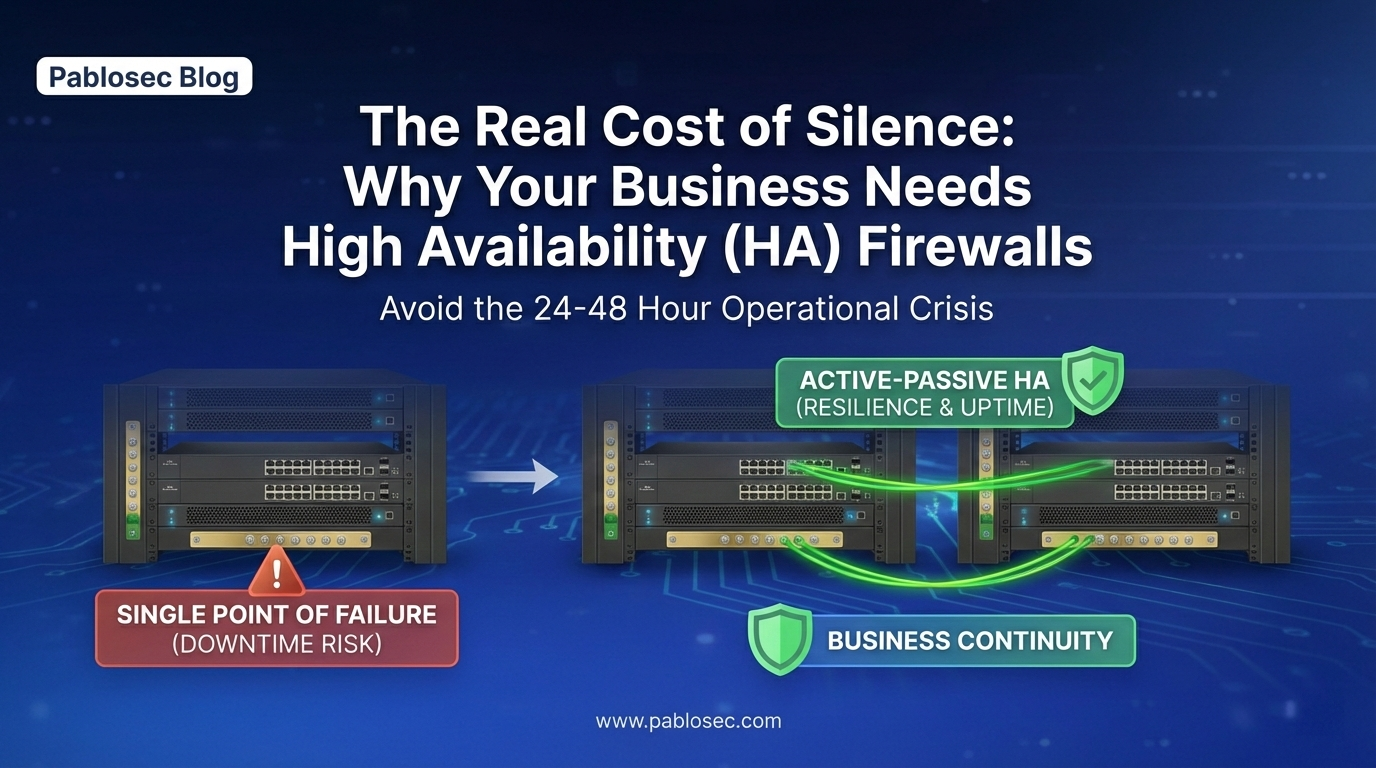
High Availability isn't magic; it's engineering for reality. It means deploying two identical firewalls that act as a single logical unit.
-
Active-Passive: One unit handles the traffic. The other monitors it, millisecond by millisecond.
-
Seamless Failover: If the primary unit fails (or a cable is cut), the secondary unit takes over instantly.
-
Session Sync: In many setups, your users won't even drop their VoIP calls during a failover.
The goal is simple: Hardware fails. Your business shouldn't.
Debunking the Myths
"We’re too small for HA."
Actually, small businesses often rely more heavily on cloud services (SaaS) than enterprises with on-premise servers. If you live in the cloud, your internet gateway is your lifeline. You need HA more, not less.
"We have backups."
A backup file is useless without hardware to restore it to. A config backup cannot route traffic.
"Our ISP has an SLA."
Your ISP guarantees the line to your building. They do not guarantee the box inside your rack. If your firewall dies, the ISP line is just a road leading to a collapsed bridge.
When HA is Non-Negotiable
You should treat HA as mandatory if:
-
You rely on VoIP/Teams for primary communication.
-
You have remote workers who cannot work without VPN access.
-
You process payments or hold customer data.
-
Your operational hours extend beyond 9-to-5 (making emergency replacements harder).
Final Thought
Downtime is the most expensive security incident you can have because it hits revenue, operations, and reputation simultaneously.
Two firewalls might cost 40% more upfront, but they are 100% cheaper than two days of total business silence.
Need a Resilience Review?
Share your current setup with us (ISP type, critical apps, user count), and we can design an HA solution that fits your budget and keeps your lights on no matter what happens to the hardware.