
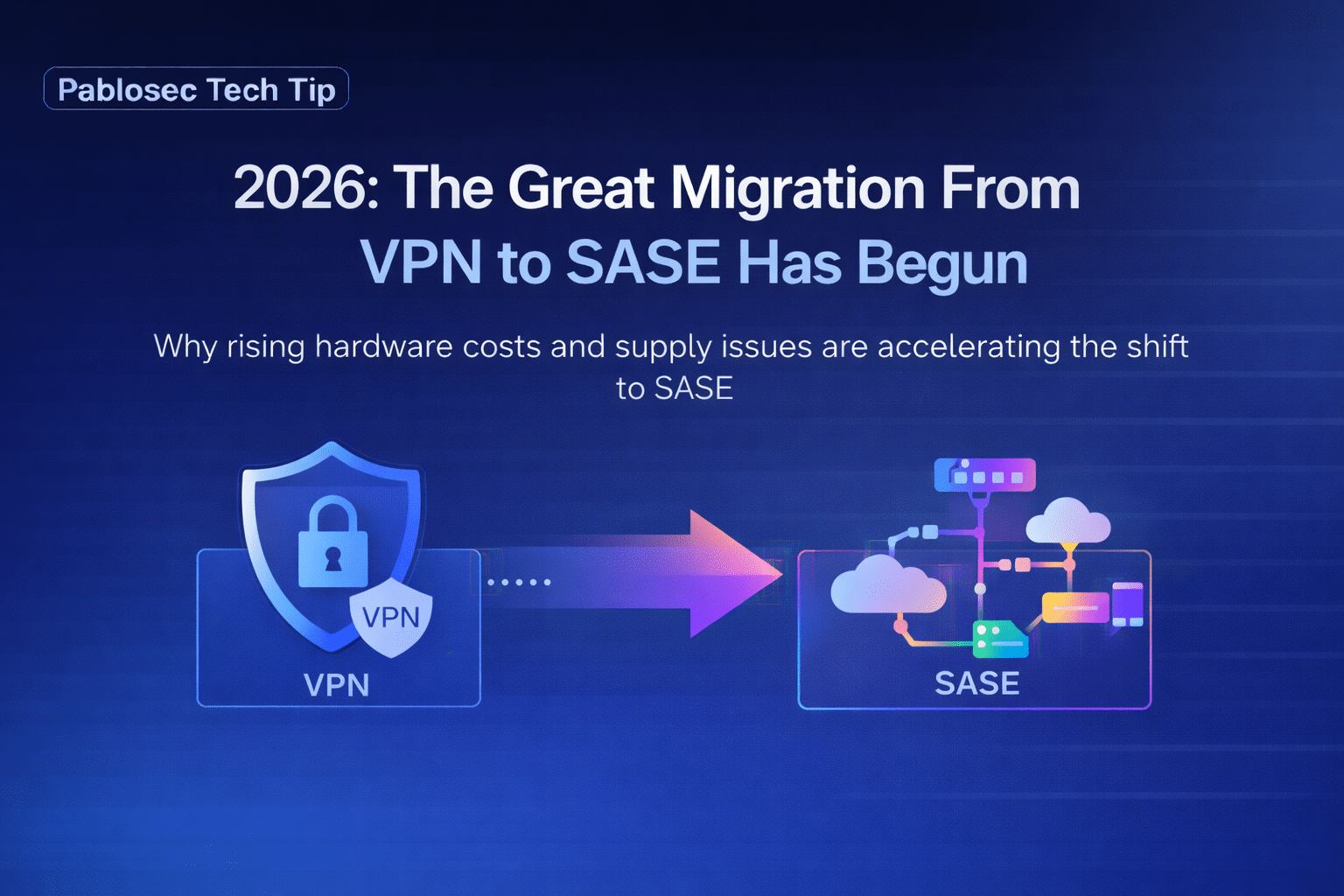
Why rising hardware costs and supply constraints are accelerating the shift and why SASE is finally “production-ready” for hybrid environments
For years, “VPN vs. SASE” was treated as a future-state debate. In 2026, it’s becoming a budget and operations decision happening right now.
Two forces are colliding:
- Remote access and security models built around VPN are struggling in cloud-first, hybrid environments (performance, lateral movement risk, operational complexity).
- Hardware is getting harder to justify longer lead times, higher component costs, and rising price pressure driven by AI-era supply constraints are influencing IT spend decisions.
The result: more organisations are moving from “we’ll migrate someday” to active SASE roadmaps.
Why VPN-centric architectures are losing momentum
Traditional VPNs were designed for a simpler world:
- users connect to a corporate network
- applications are mostly in a data centre
- security is enforced at a central perimeter
Hybrid reality breaks those assumptions:
- users are everywhere
- apps are in SaaS and multi-cloud
- traffic often gets backhauled through central sites just to be inspected, hurting performance and user experience
VPN also tends to grant network-level access after authentication, which increases blast radius if credentials are compromised (lateral movement becomes easier).
This isn’t “VPN is dead” VPN will still exist in specific cases but VPN as the default remote access model is steadily being replaced by application-level access and cloud-delivered controls.
The economic trigger in 2026: hardware becomes the expensive path
1) Supply constraints and lead times are back in the conversation
AI infrastructure demand is putting pressure on broader chip supply chains (not just GPUs). Reuters has reported worsening waits for key components like server CPUs, alongside other cost pressures in the semiconductor ecosystem. (Reuters)
2) Component costs are rising
Memory pricing and related component costs have shown sharp upward pressure tied to AI/data-centre demand. (Reuters)
3) “Chips inside networking gear” is a growing cost factor
Industry analysis has highlighted that chips are becoming a larger share of the cost base for communications and access equipment as standards evolve and performance demands increase. (PwC)
So what happens in practice?
When refresh cycles hit, organisations are looking at:
- longer procurement timelines
- higher capex for appliances
- increasing operational complexity across distributed sites
That’s exactly the moment cloud-delivered models become attractive: less dependency on hardware footprints, faster rollout, and easier scaling.
Why SASE is accelerating specifically now
SASE works because it matches how modern organisations operate:
- cloud-first apps
- hybrid users
- distributed branches
- identity as the new perimeter
And it bundles what used to be separate projects into a more coherent model:
- ZTNA (Zero Trust Network Access) for private application access
- SWG (Secure Web Gateway) for web/SaaS controls
- CASB for SaaS governance and risk
- Firewall-as-a-Service for consistent policy enforcement
- often integrated with SD-WAN for branch connectivity and traffic steering
Market forecasts (from multiple analysts) reflect that SASE adoption is not niche anymore and is expected to keep growing rapidly through the second half of the decade. (MarketsandMarkets)
“SASE is mature now” what changed vs earlier years?
A few years ago, many SASE deployments failed for predictable reasons:
- too many vendors stitched together
- inconsistent policy across components
- weak operational visibility
- messy identity and device posture integration
In 2026, the maturity story is different. The strongest SASE programs succeed because:
1) ZTNA is production-ready for hybrid access patterns
ZTNA has moved from “pilot for remote users” to “default approach” for app-level access in many environments, reducing reliance on broad network access. (Gartner)
2) Policy and identity integrations are far better than before
Organisations can enforce consistent access decisions using:
- identity signals (SSO/MFA)
- device posture (managed vs unmanaged, compliance)
- context (location, risk, app sensitivity)
3) The performance story improved
SASE architectures avoid unnecessary backhaul by bringing security enforcement closer to users and applications (cloud PoPs), which improves experience for SaaS-heavy workflows.
4) Hybrid environments are the default design target
Modern SASE designs assume:
- some apps stay on-prem
- some move to cloud
- users move between office and remote
- third parties need controlled access
This is no longer an edge case it’s the common case.
What’s pushing the “great migration” inside real organisations
Here are the board-level drivers we’re seeing repeatedly:
Security drivers
- Reduce lateral movement risk (app-level access vs network-level access)
- Enforce consistent controls for SaaS and web
- Improve visibility and policy governance across a distributed estate
Productivity drivers
- Less “VPN slow today”
- Better performance for cloud apps
- Fewer helpdesk tickets tied to tunnel issues and split tunneling edge cases
Financial and operational drivers
- Reduce dependency on frequent hardware refresh cycles
- Faster rollout to new sites/users
- Simplify operations by consolidating point tools
And in 2026 specifically, hardware cost/availability pressures are making the cloud-delivered path easier to justify. (Reuters)
A realistic migration roadmap (what actually works)
A successful VPN → SASE transition is rarely a “big bang.” The best approach is phased:
Phase 1 — Stabilise and segment remote access
- Identify your apps (not your networks)
- Group apps by sensitivity and user groups
- Define least-privilege access models
Phase 2 — Introduce ZTNA for key internal apps
- Start with high-value, well-defined apps (HR, finance, portals)
- Enforce identity + posture
- Keep VPN for legacy edge cases initially
Phase 3 — Expand to web/SaaS controls
- SWG policies for risky categories, unsanctioned SaaS, exfil control
- CASB governance for key SaaS platforms
- Standardise inspection, logging, and DLP where needed
Phase 4 — Optimise branches with SD-WAN + SASE policy
- Traffic steering based on app performance
- Consistent policy at every site without deploying “more boxes everywhere”
Common mistakes to avoid
Replacing VPN with “a different VPN” (same trust model, new interface)
- Skipping app discovery (you can’t enforce least privilege without understanding app flows)
- Overcomplicating posture on day one (start simple, improve over time)
- Ignoring user experience (bad UX = shadow IT)
- Treating SASE as only a security tool (it’s security + networking + operations)
The bottom line
2026 is the year the great migration becomes mainstream.
Not because VPN suddenly stopped working — but because hybrid reality + rising hardware friction makes VPN-centric architectures harder to defend operationally and financially.
SASE has reached the point where it is fully compatible with:
- production workloads
- hybrid infrastructures
- distributed teams
- modern SaaS-heavy businesses
And it’s increasingly the more rational long-term path.
Want a practical plan for your environment?
If you share (even at a high level):
- number of sites and remote users
- key apps (SaaS vs on-prem)
- current VPN model (full tunnel, split tunnel, vendor access)
- compliance needs (NIS2, ISO 27001, etc.)
…we can outline a phased VPN → SASE migration plan with quick wins, risk reduction milestones, and a realistic rollout timeline.